
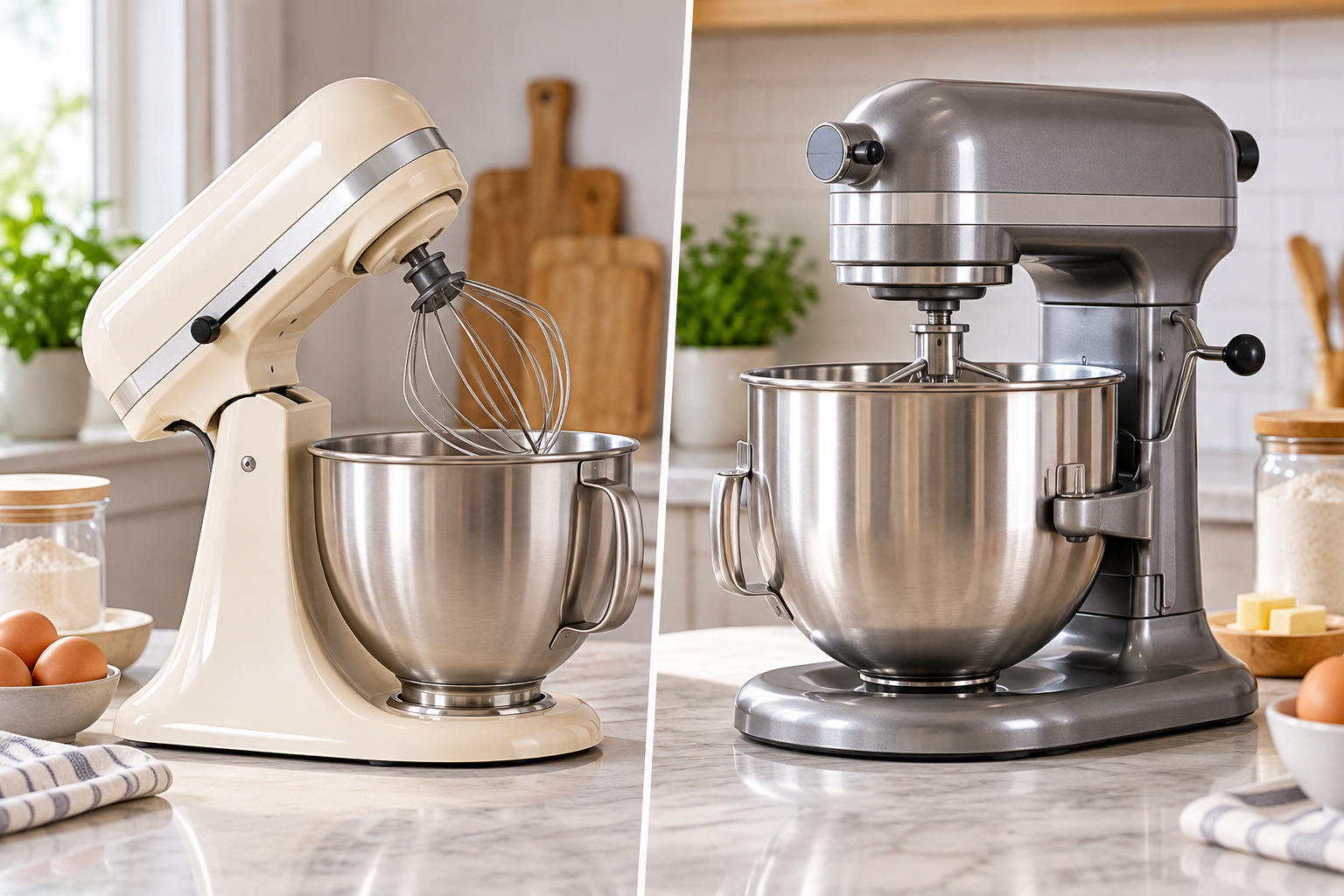
Choosing between a tilt-head and bowl-lift stand mixer can be confusing, especially if you are buying your first stand mixer. Both designs can handle common baking tasks, but they differ in size, bowl access, stability, capacity, and the types of recipes they are best suited for.
In this tilt-head vs bowl-lift stand mixer comparison, we’ll explain the key differences, advantages, and potential drawbacks of each design to help you decide which type is better for your kitchen and baking needs.
Tilt-Head vs Bowl-Lift Stand Mixer: Quick Comparison
| Feature | Tilt-Head Stand Mixer | Bowl-Lift Stand Mixer |
|---|---|---|
| Best For | Everyday home baking | Large batches and heavier mixtures |
| Bowl Access | Easy access by tilting the mixer head | Bowl moves up and down while the head stays fixed |
| Size | Generally more compact | Generally larger and heavier |
| Stability | Suitable for many everyday recipes | Often better suited to demanding mixing tasks |
| Capacity | Commonly suited to small and medium batches | Often available with larger bowl capacities |
| Storage | Usually easier in smaller kitchens | Requires more space in many cases |
What Is a Tilt-Head Stand Mixer?
A tilt-head stand mixer has a mixer head that tilts backward, allowing easier access to the mixing bowl and attachment. After adding ingredients or changing an attachment, the head is lowered and locked into position before mixing.
This design is popular for everyday home baking because it is relatively simple to use and makes it convenient to remove the bowl, scrape ingredients, or switch between attachments.
Tilt-head mixers are available in different sizes, but many models are designed for typical home recipes such as cakes, cookies, whipped ingredients, and moderate amounts of dough.
Advantages of a Tilt-Head Stand Mixer
- Easy access to the mixing bowl.
- Convenient attachment changes.
- Often more compact than larger bowl-lift models.
- Well suited to many everyday baking tasks.
- A practical design for many beginners.
Potential Drawbacks of a Tilt-Head Stand Mixer
The tilting mechanism requires vertical clearance above the mixer, which is worth considering if you plan to place the machine underneath low kitchen cabinets.
Some tilt-head models may also have smaller capacities than larger bowl-lift mixers, making them less suitable for people who frequently prepare very large batches or heavy mixtures.
What Is a Bowl-Lift Stand Mixer?
A bowl-lift stand mixer uses a fixed mixer head while the bowl is secured between support arms. A lever raises the bowl into the mixing position and lowers it when you need to remove ingredients or change attachments.
This design is commonly found on larger stand mixers intended for bigger batches or more demanding mixing tasks. Because the mixer head remains fixed, bowl-lift machines can provide a stable setup when working with heavier mixtures.
Advantages of a Bowl-Lift Stand Mixer
- Often available with larger bowl capacities.
- Stable design for demanding mixing tasks.
- Useful for larger batches.
- Can be a practical choice for frequent bread or dough preparation.
- No need to tilt the mixer head upward.
Potential Drawbacks of a Bowl-Lift Stand Mixer
Bowl-lift mixers are generally larger and heavier, so they may require more permanent counter space. Moving one in and out of storage regularly can also be less convenient.
Accessing the bowl may feel less straightforward to some beginners because the bowl must be raised and lowered instead of simply tilting the mixer head backward.
Tilt-Head vs Bowl-Lift Stand Mixer: Key Differences
1. Ease of Use
For many beginners, a tilt-head mixer offers a straightforward experience. Tilting the head backward provides direct access to the bowl and makes changing attachments simple.
A bowl-lift mixer is also easy to operate once you become familiar with it, but raising and lowering the bowl introduces a slightly different workflow.
2. Bowl Capacity
Both designs are available in different capacities, so the exact bowl size depends on the model rather than the design alone.
However, bowl-lift mixers are often associated with larger capacities and may be more suitable for people who regularly prepare large batches. A medium-sized tilt-head mixer can be sufficient for many everyday home recipes.
3. Stability and Heavy Dough
Bowl-lift mixers are often chosen for heavier mixing tasks because their fixed-head design and larger frames can provide additional stability.
This does not mean that a tilt-head mixer cannot knead dough. Many tilt-head models can handle dough effectively when used within the manufacturer’s recommended capacity and speed limits.
4. Kitchen Space
A tilt-head mixer may have a smaller overall footprint, but you need enough vertical clearance to raise the head. This can matter when placing the mixer underneath kitchen cabinets.
A bowl-lift mixer does not require the head to tilt upward, but the machine itself is often taller, heavier, and larger.
Always check the exact dimensions of a mixer before buying rather than relying only on its design type.
5. Batch Size
If you usually make cakes, cookies, whipped cream, or moderate batches of dough, a tilt-head mixer may provide enough capacity and convenience.
If you frequently prepare larger batches or heavier doughs, a bowl-lift model may be worth considering, particularly when paired with a larger bowl.
6. Price
Price varies considerably between brands, capacities, and features. Tilt-head mixers are available at both budget and premium price points, while larger bowl-lift models can cost more because of their size, capacity, and intended workload.
Instead of choosing based on price alone, consider how often you will use the mixer and whether you actually need the additional capacity of a larger model.
Which Is Better for Beginners: Tilt-Head or Bowl-Lift?
For many beginners and everyday home bakers, a tilt-head stand mixer is a practical starting point. Easy bowl access, convenient attachment changes, and generally manageable dimensions make the design suitable for common baking tasks.
A bowl-lift stand mixer may be the better choice if you already know that you will frequently prepare large batches, heavier doughs, or recipes that benefit from greater capacity and stability.
Neither design is automatically better for everyone. The right choice depends on your recipes, available kitchen space, batch size, and how frequently you plan to use the mixer.
Who Should Choose a Tilt-Head Stand Mixer?
A tilt-head model may be a better fit if you:
- Are buying your first stand mixer.
- Mostly prepare everyday home baking recipes.
- Want easy access to the bowl and attachments.
- Have limited counter or storage space.
- Usually prepare small or medium batches.
Who Should Choose a Bowl-Lift Stand Mixer?
A bowl-lift model may be worth considering if you:
- Frequently prepare large batches.
- Regularly knead heavier doughs.
- Want a larger-capacity mixer.
- Have enough permanent counter space.
- Expect to use your stand mixer frequently for demanding recipes.
Frequently Asked Questions
Is a bowl-lift mixer better than a tilt-head mixer?
Not necessarily. Bowl-lift mixers can be useful for larger batches and demanding mixing tasks, while tilt-head mixers are often more convenient for everyday home baking. The better choice depends on your recipes, space, and desired capacity.
Is a tilt-head stand mixer good for beginners?
Yes. A tilt-head stand mixer can be a practical choice for beginners because the bowl and attachments are easy to access, and many models provide enough capacity for common home baking recipes.
Can a tilt-head mixer knead bread dough?
Many tilt-head stand mixers can knead bread dough, but capacity and recommended kneading speeds vary by model. Follow the manufacturer’s instructions and avoid exceeding the recommended amount of dough.
Are bowl-lift stand mixers only for professional bakers?
No. Home bakers can also use bowl-lift mixers. They may be particularly useful for people who bake frequently, prepare large batches, or regularly work with heavier mixtures.
Which stand mixer takes up less space?
Tilt-head mixers are often more compact, but they require additional vertical clearance when the head is raised. Bowl-lift mixers do not tilt upward but are often larger overall. Check the dimensions of the specific models you are comparing.
Final Thoughts
When comparing a tilt-head vs bowl-lift stand mixer, focus on how you actually plan to use the machine rather than assuming one design is always superior.
A tilt-head mixer is often a convenient choice for beginners, everyday baking, and moderate batches. A bowl-lift mixer can make more sense for frequent baking, larger quantities, and heavier mixing tasks.
If you are still choosing your first mixer, read our best stand mixer for beginners guide to compare important features before buying.
If you already own a mixer and want help getting started, see our how to use a stand mixer guide for step-by-step instructions on attachments, speed settings, mixing, and cleaning.