
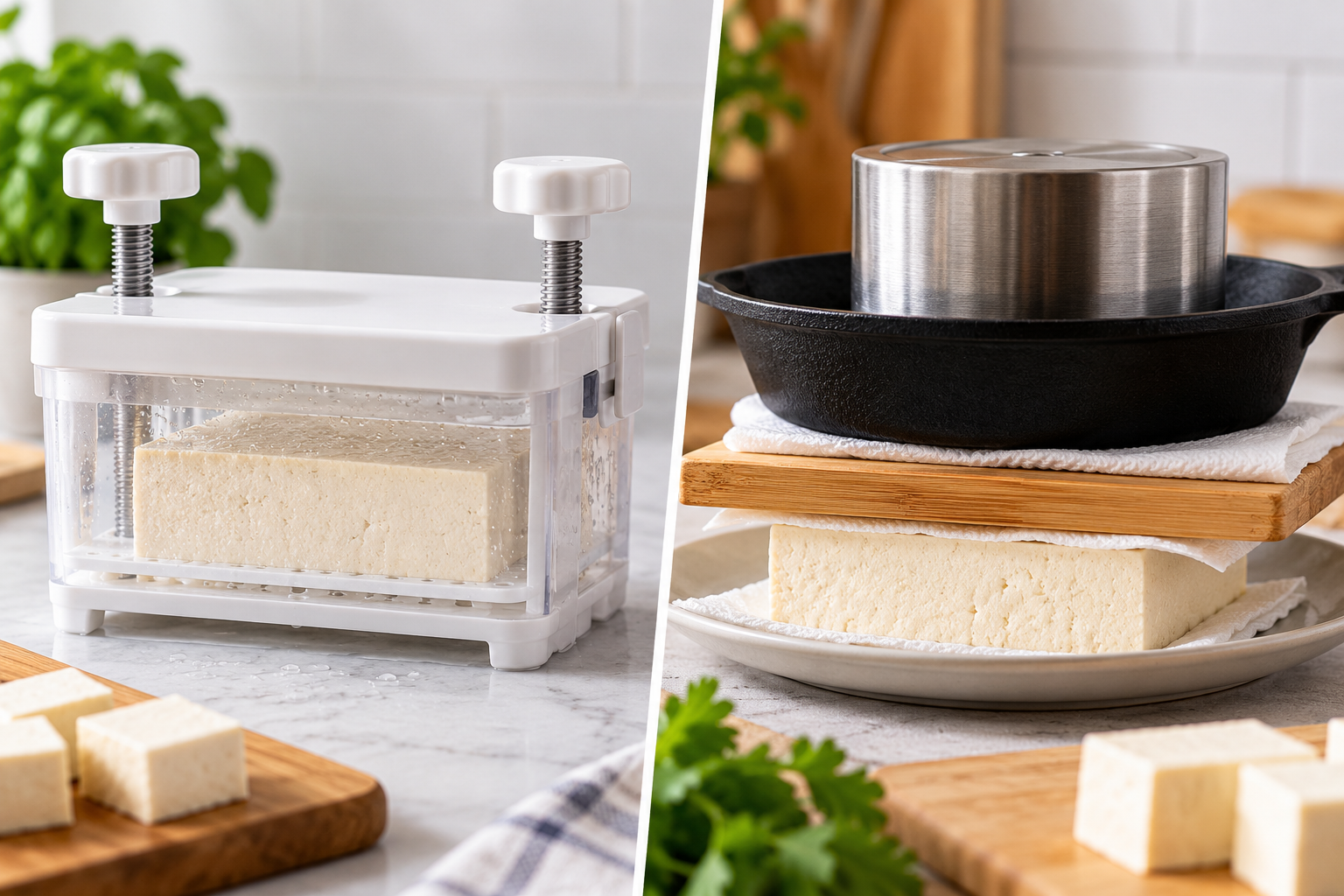
If you regularly cook tofu, you may wonder whether a dedicated tofu press is actually worth buying or if a simple DIY method works just as well.
In this tofu press vs DIY method comparison, we’ll look at convenience, pressure, drainage, cleanup, and storage to help you decide which option makes more sense for your kitchen.
Tofu Press vs DIY Method: Quick Comparison
| Feature | Tofu Press | DIY Method |
| Ease of Use | Easy | Requires setup |
| Pressure | More controlled | Depends on the weights used |
| Drainage | Often built in | Usually needs a plate or tray |
| Storage | Requires dedicated space | Uses items you already own |
| Cost | Requires a purchase | Usually no additional cost |
How Does a Tofu Press Work?
A tofu press holds the tofu block between surfaces that apply pressure to remove excess moisture. Depending on the design, the pressure may come from a screw, spring, or tension-based mechanism.
Many tofu presses also provide a dedicated area for the released liquid to drain or collect. This can make the process more organized and repeatable than setting up household objects each time you prepare tofu.
How Does the DIY Tofu Press Method Work?
The DIY method usually involves placing the tofu between plates, cutting boards, or other flat surfaces and adding a weighted object on top. The pressure gradually pushes moisture out of the tofu.
This method can work without buying a dedicated tool, but it requires a stable setup and a place for the released liquid to drain. You also need to position the weight carefully so the tofu is pressed evenly without being crushed.
Tofu Press vs DIY Method: Key Differences
1. Convenience
A dedicated tofu press is generally more convenient because it is designed specifically to hold the tofu and apply pressure without requiring you to build a setup each time.
The DIY method uses items you already have, but arranging plates, boards, and weights can take more preparation. If you press tofu frequently, the simpler setup of a dedicated press may be more practical.
2. Pressure Control
A tofu press can provide more predictable pressure because the mechanism is designed to press the tofu evenly. Adjustable models may also let you increase or decrease the pressure gradually.
With the DIY method, pressure depends on the objects you place on top of the tofu. Using too much weight or positioning it unevenly can increase the chance of cracking or crushing the tofu.
3. Drainage and Cleanup
Some tofu presses include a container or tray that collects the liquid released from the tofu. This can help keep the countertop cleaner and make disposal easier.
With a DIY setup, you usually need a plate, tray, or another container to catch the liquid. Cleanup is still simple, but there may be more individual items to wash afterward.
4. Cost
The DIY method usually has the advantage when it comes to cost because you can use plates, cutting boards, or other items you already have at home.
A dedicated tofu press requires an additional purchase. Whether that cost is worthwhile depends largely on how often you prepare tofu and how much you value a faster, more organized setup.
5. Storage
A dedicated tofu press needs its own storage space, which may matter if your kitchen cabinets or drawers are already crowded. Some models are compact, while others include multiple parts that take up more room.
The DIY method does not require storing another kitchen tool because it uses items you already own. This can be an advantage if you prepare tofu only occasionally or prefer to keep specialty tools to a minimum.
Which Method Is Better for Beginners?
For beginners who only prepare tofu occasionally, the DIY method can be a practical place to start. It costs little or nothing and lets you see whether pressing tofu becomes a regular part of your cooking routine.
If you prepare tofu frequently, a dedicated tofu press may be more convenient because it provides a repeatable setup with less balancing and preparation.
Neither method is automatically better for everyone. The right choice depends on how often you cook tofu, your available storage space, and whether convenience is worth the additional cost to you.
Frequently Asked Questions
Do you really need a tofu press?
No, you do not necessarily need a tofu press to remove excess moisture from tofu. A simple DIY setup using flat surfaces and a carefully positioned weight can also work.
A dedicated tofu press mainly adds convenience and a more consistent setup. It may be more useful if you prepare tofu regularly, while occasional tofu cooks may be satisfied with the DIY method.
Does a tofu press work better than using weights?
A tofu press is designed to apply pressure in a controlled and repeatable way, while a DIY method depends on the weight and setup you use.
Both methods can remove moisture from tofu. The main advantage of a dedicated press is convenience and consistency rather than the idea that a DIY method cannot work.
Final Thoughts
When comparing a tofu press vs DIY method, both can remove excess moisture from tofu effectively. The main differences are convenience, pressure control, storage, cleanup, and cost.
A DIY method can be a practical choice if you prepare tofu occasionally and want to use items you already own. A dedicated tofu press may be worth considering if you cook tofu regularly and prefer a simpler, more repeatable setup.
Choose the method that best fits your cooking habits, kitchen space, and budget rather than assuming that one option is necessary for everyone.
If you decide that a dedicated press is right for you, read our best tofu press for beginners guide to compare the main types, features, and beginner-friendly options.
Already have a press? Our guide on how to use a tofu press explains the process step by step, from draining the tofu to applying pressure and removing it from the press.
Not sure whether you need a dedicated press? Read our tofu press vs DIY method comparison to see how a tofu press compares with a simple setup using items you may already have at home.
1 thought on “Tofu Press vs DIY Method: Which Is Better?”