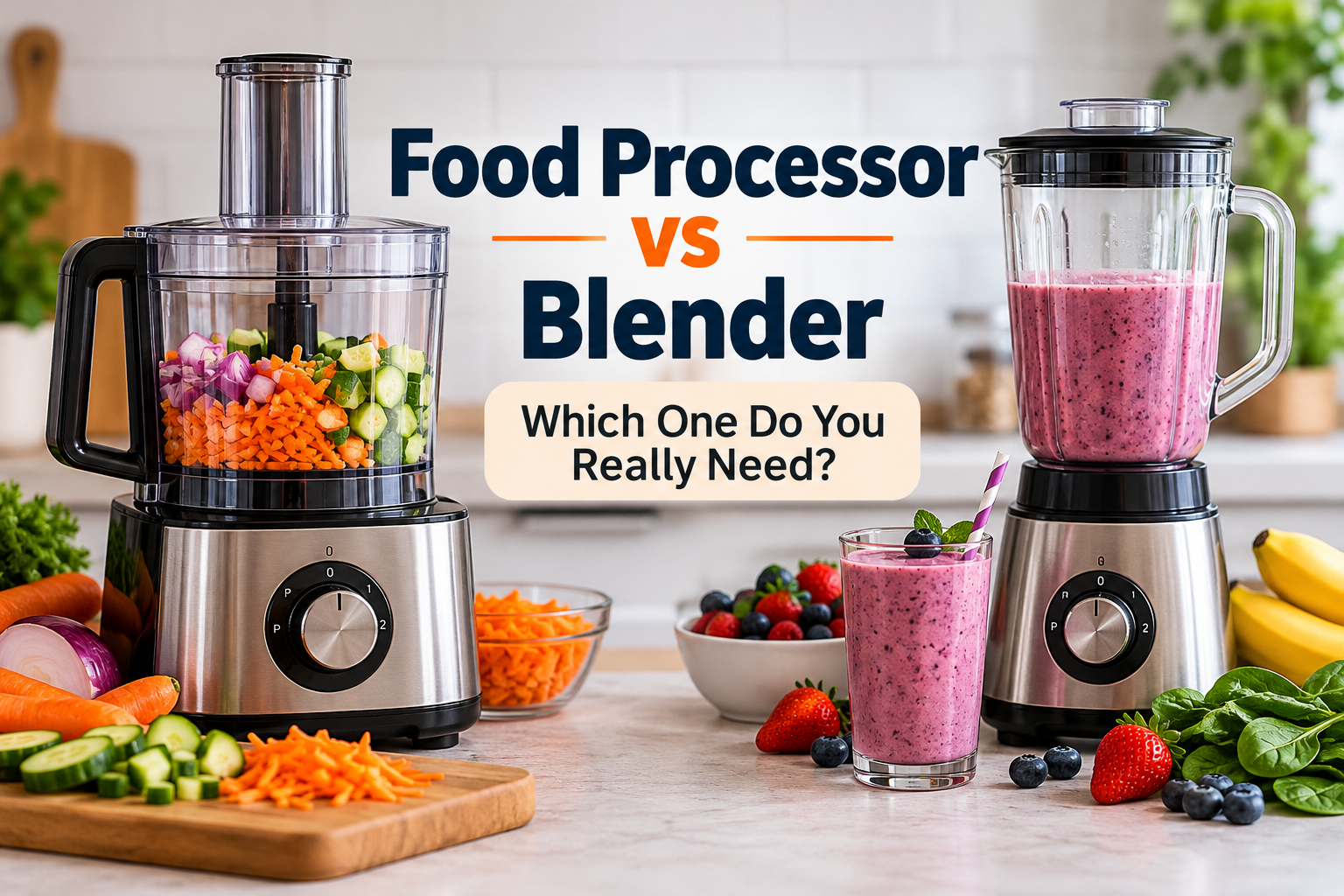
Food processor vs blender: which kitchen appliance should you buy? Both machines can save time during food preparation, but they are designed for different tasks. A food processor is generally better for chopping, slicing, shredding, and preparing thicker mixtures, while a blender is usually the better choice for smoothies, drinks, and liquid-heavy recipes.
The right choice depends on what you cook most often, how much counter space you have, and whether you need an appliance for meal preparation or beverages.
In this guide, we compare food processors and blenders, explain their strengths and limitations, and help you decide whether you need one appliance or both.
Food Processor vs Blender: Quick Answer
Choose a food processor if you frequently chop vegetables, shred cheese, slice ingredients, prepare thick dips, or make recipes that benefit from interchangeable blades and discs.
Choose a blender if you primarily make smoothies, shakes, blended soups, drinks, or other recipes that contain enough liquid to circulate properly.
If you regularly prepare both chopped ingredients and blended drinks, owning both appliances may be worthwhile. However, many beginners can start with just one based on their most common recipes.
Food Processor vs Blender Comparison Table
| Feature | Food Processor | Blender |
|---|---|---|
| Best for | Chopping, slicing, shredding, thick mixtures | Smoothies, drinks, liquid-based blending |
| Typical container | Wide work bowl | Tall blending jar |
| Attachments | May include multiple blades and discs | Usually uses a fixed blending blade |
| Vegetable chopping | Generally better for controlled chopping | Less suitable for precise, even chopping |
| Slicing and shredding | Available with compatible discs | Usually not supported |
| Smoothies | Not usually the best option | Generally the better choice |
| Thick dips | Often well suited | Possible with suitable models and recipes |
| Counter space | Varies by model and attachments | Varies by jar size and motor base |
| Cleaning | May involve several removable parts | Often involves fewer main components |
Note: Capabilities vary by model. Some premium blenders and multifunction food processors can perform tasks beyond these typical categories.
What Is a Food Processor?
A food processor is a countertop appliance designed to handle a range of food preparation tasks. It typically uses a wide bowl and interchangeable attachments to process ingredients in different ways.
Depending on the model, a food processor may chop vegetables, shred cheese, slice potatoes, mix ingredients, or prepare thick sauces and dips.
Advantages of a Food Processor
- Useful for chopping large quantities of vegetables.
- Can offer slicing and shredding attachments.
- Suitable for many meal preparation tasks.
- Often provides better control over coarse chopping through pulse settings.
- Can reduce repetitive knife and grater work.
Disadvantages of a Food Processor
- Usually less suitable for smoothies and thin drinks.
- Attachments can require additional storage space.
- May involve more parts to clean.
- Some models are bulky for small kitchens.
- Performance and available functions vary by model.
If you are considering buying one, read our best food processor for beginners buying guide for a closer look at bowl capacity, useful features, and beginner-friendly options.
What Is a Blender?
A blender is designed primarily to combine and break down ingredients into smooth mixtures. Most countertop blenders use a tall jar and rotating blades that work especially well when ingredients can circulate with sufficient liquid.
Blenders are commonly used for smoothies, milkshakes, sauces, and blended soups, provided the appliance is suitable for the ingredients and temperatures involved.
Advantages of a Blender
- Generally excellent for smoothies and blended beverages.
- Useful for creating smooth liquid-based mixtures.
- Often straightforward to operate.
- Available in compact personal and larger countertop designs.
- Can be convenient for everyday drinks and sauces.
Disadvantages of a Blender
- Usually cannot slice or shred ingredients with separate discs.
- Less suitable for controlled coarse chopping.
- Thick mixtures may require special settings or careful handling.
- Some recipes need additional liquid to blend effectively.
- Performance varies considerably between basic and high-powered models.
Food Processor vs Blender: Which Is Better for Different Tasks?
Chopping Vegetables
Winner: Food processor.
A food processor is generally the more practical choice for chopping onions, carrots, peppers, and similar ingredients. Short pulses allow you to control the texture without turning everything into a puree.
Making Smoothies
Winner: Blender.
Blenders are specifically designed to combine fruits, liquids, and other suitable ingredients into a drinkable consistency. A food processor may mix some of these ingredients, but it is not usually the most convenient option for smoothies.
Shredding Cheese
Winner: Food processor with a shredding disc.
Many food processors include or support a shredding attachment that can prepare cheese quickly. A standard blender does not typically provide this function.
Preparing Hummus and Thick Dips
Winner: Depends on the recipe and appliance.
Food processors are often convenient for thick dips because their bowl design can accommodate dense mixtures. Some blenders, especially models designed for thick recipes, can also produce smooth results.
Blending Soups
Winner: Blender, when suitable for the soup and its temperature.
A blender is generally better for producing a smooth, liquid-based soup. However, hot ingredients require special care. Never blend hot liquids unless the manufacturer specifically allows it and provides safe operating instructions.
Making Dough
Winner: Depends on the dough and machine.
Some food processors can prepare certain dough recipes, while standard blenders are usually not designed for kneading. Always check the manufacturer’s dough capacity and processing limits.
Should You Buy a Food Processor or a Blender First?
If you are purchasing your first major food preparation appliance, consider the recipes you make most frequently.
Buy a Food Processor First If You:
- Cook meals from scratch several times a week.
- Frequently chop vegetables or prepare salads.
- Want to shred cheese or slice ingredients efficiently.
- Make thick dips, fillings, or similar mixtures.
- Want an appliance that reduces manual preparation work.
Buy a Blender First If You:
- Make smoothies or protein shakes regularly.
- Prefer blended drinks and liquid-based recipes.
- Often prepare smooth sauces or suitable blended soups.
- Do not need slicing or shredding attachments.
- Want an appliance primarily for beverages.
Do You Need Both a Food Processor and a Blender?
Not everyone needs both appliances. If your cooking routine focuses mainly on smoothies and drinks, a blender may be enough. If you mostly prepare vegetables, fillings, and other meal ingredients, a food processor may offer more value.
Owning both becomes more useful when you frequently switch between food preparation tasks and liquid-based blending.
Before purchasing two machines, consider your available storage space, cleaning preferences, and how often you would use each one.
What to Look for Before Buying Either Appliance
Capacity
Choose a bowl or jar size that matches your usual serving quantities. A large appliance may be unnecessary for small portions, while a compact model may require several batches for family meals.
Ease of Cleaning
Look for removable components that are easy to access and clean. Check the manufacturer’s guidance to see whether specific parts are dishwasher-safe.
Controls and Settings
Simple controls can be helpful for beginners. Pulse settings are especially useful for food processors, while appropriate speed options can improve flexibility in blenders.
Storage Space
Measure your available countertop and cabinet space before buying. Remember to account for attachments, bowls, jars, and lids.
Recipe Compatibility
Make sure the appliance supports the tasks you actually plan to perform. Do not assume that every blender can process thick mixtures or that every food processor can handle heavy dough.
How to Use a Food Processor Safely
If you decide that a food processor is the better option, learning the correct setup and operating technique is important.
Always secure the bowl and lid, use the correct attachment, avoid overfilling, and keep your hands away from moving blades. Unplug the machine before handling sharp attachments or cleaning.
For detailed instructions, see our step-by-step guide on how to use a food processor.
Common Mistakes When Choosing Between a Food Processor and Blender
Assuming Both Appliances Do the Same Jobs
Although some functions overlap, their typical strengths differ. Choose based on your main recipes rather than appearance or marketing claims alone.
Buying Based Only on Motor Power
Motor wattage is not a complete measure of real-world performance. Blade design, container shape, controls, and overall construction also matter.
Choosing a Capacity That Does Not Fit Your Needs
An oversized machine may be inconvenient for small recipes, while an undersized one may require repeated batches.
Ignoring Cleaning and Storage
An appliance that is difficult to clean or store may be used less often, even if it offers impressive features.
Frequently Asked Questions
Is a food processor better than a blender?
A food processor is generally better for chopping, slicing, shredding, and many thick mixtures. A blender is generally better for smoothies, drinks, and liquid-based blending. Neither appliance is universally better.
Can a blender replace a food processor?
A blender can handle some mixing and pureeing tasks, but it usually cannot replace a food processor’s slicing and shredding functions. It may also be less convenient for controlled coarse chopping.
Can a food processor make smoothies?
Some food processors can combine smoothie ingredients, but a blender is usually more suitable for producing smooth, drinkable results. Always follow the manufacturer’s liquid capacity limits.
Which appliance is easier to clean?
It depends on the design. Blenders often have fewer main components, while food processors may include several blades and discs. Check cleaning instructions for the specific models you are comparing.
Which is better for a small kitchen?
The better choice is the appliance you will use most often. Compact blenders and smaller food processors are available, but you should compare their dimensions and storage requirements before purchasing.
Is a food processor worth buying if I already have a blender?
It can be worthwhile if you frequently chop vegetables, slice ingredients, or shred cheese. If you mainly prepare smoothies and blended drinks, you may not need a separate food processor.
Final Verdict: Food Processor or Blender?
The decision comes down to how you cook.
Choose a food processor for everyday ingredient preparation, controlled chopping, slicing, shredding, and compatible thick mixtures.
Choose a blender for smoothies, drinks, and smooth liquid-based recipes.
If both types of recipes are part of your regular routine, the two appliances can complement each other rather than compete.
For help choosing a beginner-friendly food processor, explore our food processor buying guide. You can also learn how to get started with our food processor tutorial for beginners.
3 thoughts on “Food Processor vs Blender: Which One Do You Really Need?”