Affiliate Disclosure: This article contains affiliate links. If you purchase through one of these links, we may earn a commission at no additional cost to you. As an Amazon Associate I earn from qualifying purchases.
Sous vide vs slow cooker: which one is better for your kitchen? Both appliances can cook food over several hours, but they use very different methods and produce different results.
A sous vide machine circulates water at a carefully selected temperature while food cooks in a suitable sealed bag. A slow cooker heats food directly inside a covered pot, making it especially useful for stews, braises, soups, and other one-pot meals.
Quick answer: Choose sous vide if precise temperature control and consistent doneness are your priorities. Choose a slow cooker if you want convenient one-pot meals, tender braised meats, and minimal preparation. Neither appliance is universally better; the right choice depends on what you cook most often.
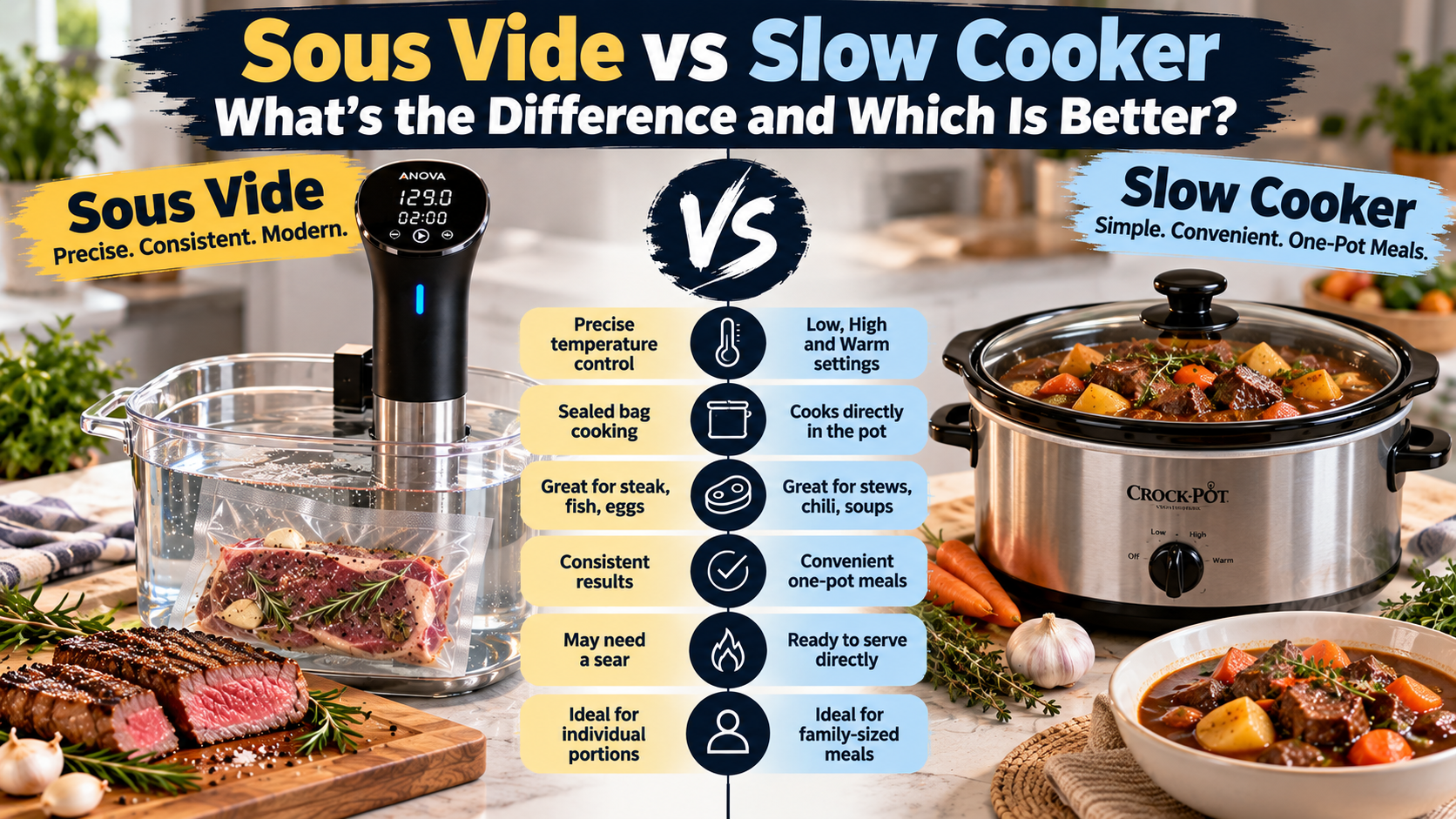
Sous Vide vs Slow Cooker: Quick Comparison
| Feature | Sous Vide Machine | Slow Cooker |
|---|---|---|
| Cooking method | Precisely controlled circulating water bath | Heat applied to a covered cooking pot |
| Food packaging | Usually requires suitable sealed bags | Food cooks directly in the pot |
| Temperature control | Select a specific water temperature | Usually Low, High, and sometimes Warm settings |
| Best for | Steak, fish, eggs, and precision-focused cooking | Stews, chili, soups, pot roast, and braised dishes |
| Cooking liquid | Food generally stays sealed away from the bath water | Ingredients cook together with their liquids and sauces |
| Typical finish | Meat may need a separate sear | Many meals are ready to serve directly |
| Meal preparation | Individual portions and precisely cooked ingredients | Large batches and one-pot meals |
| Beginner learning curve | Requires understanding safe time-and-temperature combinations | Generally straightforward when following tested recipes |
Both methods require safe food handling and appropriate cooking instructions. Cooking time varies considerably by recipe.
What Is Sous Vide Cooking?
Sous vide cooking uses an immersion circulator to heat and move water around a container. The machine maintains the water near a selected temperature while food cooks inside suitable packaging.
For example, a cook may use sous vide to prepare a steak with a consistent interior temperature before finishing it with a quick sear. The technique is also useful for fish, eggs, vegetables, and other foods when the correct time-and-temperature procedure is followed.
Advantages of Sous Vide
- Precise temperature selection: You can set a specific water-bath temperature.
- Consistent results: Controlled water temperature can help reduce unwanted variation in doneness.
- Flexible portions: Individual portions can be packaged and cooked separately.
- Useful for delicate foods: Particularly appealing when texture and precise cooking are important.
Disadvantages of Sous Vide
- Requires suitable food-safe bags and a water container.
- Some recipes take several hours or longer.
- Meat often benefits from a separate browning step.
- Food safety depends on both cooking temperature and sufficient time.
- It is less convenient for dishes where ingredients should simmer together in a sauce.
New to the technique? Read our step-by-step guide to using a sous vide machine.
What Is a Slow Cooker?
A slow cooker is a countertop appliance that cooks ingredients inside a covered pot over an extended period. Most models offer Low and High cooking settings, and some also include a Keep Warm function.
Slow cookers are especially useful for recipes where meat, vegetables, broth, and seasonings cook together. They are popular for chili, soups, pulled meat, stews, and pot roast.
Unlike sous vide, a slow cooker does not generally let you select a precise target temperature for the center of a steak. Instead, it gradually heats the food and cooking liquid over time.
Advantages of a Slow Cooker
- Convenient one-pot cooking: Many recipes require only basic preparation.
- Good for tougher cuts: Long, moist cooking can soften connective tissue.
- Suitable for family meals: Many models can prepare several servings at once.
- Minimal extra equipment: No separate cooking bags or water bath are normally required.
- Easy cleanup options: Many models have removable cooking inserts.
Disadvantages of a Slow Cooker
- Less control over precise doneness.
- Some ingredients can become overly soft after extended cooking.
- Delicate fish and lean cuts may be harder to cook to a specific texture.
- Long cooking times require advance planning.
- Recipes need appropriate liquid levels and safe cooking procedures.
1. Temperature Control: Which Is More Precise?
Winner: Sous vide.
Temperature control is the biggest difference between these appliances.
A sous vide immersion circulator is designed to maintain a selected water temperature. This makes it useful for recipes where a relatively small temperature difference can noticeably affect texture.
A slow cooker usually offers broader settings such as Low and High. These settings control the cooking process, but they are not equivalent to selecting an exact internal food temperature.
That does not make a slow cooker inferior. It simply makes it better suited to recipes that benefit from prolonged moist heat rather than narrowly controlled doneness.
2. Food Texture: Which Produces Better Results?
It depends on the dish.
Sous Vide Texture
Sous vide is especially useful when you want consistent cooking throughout a piece of food. With a properly selected and validated recipe, it can produce predictable textures in steak, fish, eggs, and other ingredients.
However, sous vide does not automatically produce a browned crust. Steak and similar foods often need a separate sear.
Slow Cooker Texture
Slow cooking is excellent for meals where ingredients are meant to soften and blend together. Tougher cuts of meat can become tender during long, moist cooking, while sauces and cooking liquids develop together in the pot.
For a hearty beef stew, a slow cooker may be more convenient than sous vide. For a steak where precise doneness is the main goal, sous vide is usually the more appropriate technique.
3. Cooking Time: Is Sous Vide Faster Than a Slow Cooker?
Neither method is consistently faster.
Both can involve extended cooking times, and the duration depends on the recipe, food thickness, starting temperature, and desired result.
Some sous vide preparations can be completed in a relatively short session, while others require many hours. Slow cooker recipes also vary, with many meals designed around several hours on Low or High.
The important distinction is not simply speed:
- Sous vide: Cooking time is selected alongside a precise water temperature.
- Slow cooker: Cooking time is generally selected according to a tested recipe and the appliance’s cooking setting.
Always follow reliable food-specific cooking instructions rather than assuming that longer cooking automatically makes a meal safer or better.
4. Convenience: Which Is Easier for Beginners?
Winner for one-pot meals: Slow cooker.
A slow cooker is often easier for beginners who want to prepare a complete meal with minimal extra equipment. Many recipes involve adding prepared ingredients, selecting the recommended setting, and allowing the food to cook.
Sous vide requires a few additional steps:
- Fill a suitable container with water.
- Attach and configure the immersion circulator.
- Package the food in suitable bags.
- Keep the food submerged.
- Follow the recipe’s validated time and temperature.
- Finish the food separately if needed.
These steps become familiar with practice, but a slow cooker is generally the more straightforward option for soups, chili, and braised meals.
5. Versatility: Which Can Cook More Types of Meals?
Both appliances are versatile, but they specialize in different tasks.
| Food or Meal | Better Starting Choice | Why |
|---|---|---|
| Steak with precise doneness | Sous vide | Controlled water temperature |
| Beef stew | Slow cooker | Ingredients simmer together |
| Chili | Slow cooker | Convenient one-pot preparation |
| Delicate fish | Sous vide | Useful temperature control |
| Pot roast | Slow cooker | Well suited to long, moist cooking |
| Precisely cooked eggs | Sous vide | Controlled temperature and texture |
| Soup | Slow cooker | Broth and ingredients cook together |
| Individually portioned proteins | Sous vide | Separate sealed portions |
These are practical recommendations, not strict rules. Some dishes can be prepared using either method with an appropriate recipe.
6. Cost: Is Sous Vide or a Slow Cooker Cheaper?
Purchase prices vary by brand, capacity, and features, so it is better to compare the full setup than to assume one appliance is always cheaper.
A sous vide setup may require:
- An immersion circulator.
- A compatible pot or water container.
- Suitable cooking bags.
- Optional vacuum-sealing equipment.
A slow cooker generally includes its cooking vessel, so fewer separate accessories may be necessary.
Operating costs also depend on power consumption, cooking duration, insulation, water volume, and the particular appliance. Neither method is guaranteed to use less electricity in every situation.
If you are interested in sous vide accessories, see our best vacuum sealers for beginners guide.
7. Food Safety: Important Differences
Both methods can be safe when used correctly, but their safety requirements are not interchangeable.
Slow Cooker Safety
The USDA recommends thawing meat and poultry before placing them in a slow cooker. Use an appropriately sized cooker, follow tested recipes, and keep the lid in place as directed.
The Keep Warm setting is intended for holding properly cooked food hot, not for cooking raw food.
Sous Vide Safety
With sous vide, safe cooking depends on the selected temperature, the food’s thickness, its starting temperature, and the time it remains at the required temperature.
Do not assume that setting the water bath to a particular temperature instantly makes food safe. Use validated sous vide cooking guidance and suitable food-safe packaging.
For both methods, prevent cross-contamination and refrigerate leftovers promptly. For official recommendations, consult the USDA slow cooker food safety guide and USDA food safety basics.
Which Should You Buy First?
Choose a Sous Vide Machine If You:
- Frequently cook steak, fish, or other foods where precise doneness matters.
- Enjoy experimenting with cooking techniques.
- Do not mind using cooking bags and a water container.
- Want more direct control over cooking temperature.
- Are comfortable following detailed time-and-temperature instructions.
Choose a Slow Cooker If You:
- Frequently prepare soups, stews, chili, or braised meat.
- Want a convenient appliance for family-sized meals.
- Prefer cooking ingredients together in one pot.
- Want fewer accessories and preparation steps.
- Prefer straightforward recipes with Low and High settings.
Recommended Sous Vide Machines for Beginners
If sous vide sounds right for you, explore our beginner-friendly sous vide machine comparison and learn how to use a sous vide machine step by step.
If precise temperature control sounds more useful for your cooking style, these three immersion circulators offer different approaches.
Anova Precision Cooker 3.0 — Flexible All-Around Choice
The Anova Precision Cooker 3.0 combines built-in controls with Wi-Fi connectivity. It is worth considering if you want to control your cooking directly on the device while retaining access to connected features.
Check Anova Precision Cooker 3.0 on Amazon
Breville Joule Turbo — For App-Guided Cooking
The Breville Joule Turbo is designed around a connected cooking experience. It may appeal to beginners who enjoy following app-based guidance and want access to supported Turbo cooking features.
Check Breville Joule Turbo on Amazon
Greater Goods Sous Vide Cooker — For Simple Controls
The Greater Goods Sous Vide Cooker offers an alternative for cooks who prefer adjusting settings directly on the appliance without relying on a smartphone app.
Check Greater Goods Sous Vide Cooker on Amazon
For a closer comparison of these models, visit our best sous vide machines for beginners buying guide.
Frequently Asked Questions
Is sous vide the same as slow cooking?
No. Sous vide uses a controlled water bath and suitable sealed packaging. A slow cooker heats food directly in a covered pot, typically using Low or High settings. Both can cook for long periods, but the techniques and results differ.
Can a sous vide machine replace a slow cooker?
Not completely. Sous vide can prepare many proteins and other ingredients precisely, but it is not as convenient for one-pot soups, chili, and stews where ingredients should cook together in liquid.
Can you use a slow cooker for sous vide?
A conventional slow cooker is not a direct substitute for an immersion circulator. Its Low and High settings generally do not provide the precise water-temperature control required by sous vide recipes.
Which is better for steak?
Sous vide is generally better when your main goal is precise internal doneness. A slow cooker is more appropriate for steak or beef recipes intended to become very tender through prolonged moist cooking.
Which is better for meal prep?
Both can be useful. A slow cooker is convenient for preparing large batches of complete meals, while sous vide can be useful for individually portioned ingredients prepared with appropriate cooking and cooling procedures.
Is a slow cooker safer than sous vide?
Neither is automatically safer in every situation. Both can be used safely when you follow suitable recipes, maintain appropriate cooking conditions, and handle food correctly. Sous vide requires particular attention to validated time-and-temperature combinations.
Can you leave sous vide or slow cooker food cooking overnight?
Some recipes are designed for long cooking periods, but do not assume overnight cooking is appropriate for every food. Follow the appliance manufacturer’s instructions and a validated recipe, maintain the required conditions, and account for possible interruptions or water loss.
Final Verdict: Sous Vide vs Slow Cooker
The best choice depends on your cooking habits.
Choose sous vide when precise temperature control and predictable doneness matter most. It is especially useful for foods where texture changes noticeably with temperature.
Choose a slow cooker when you want convenient one-pot meals, tender braised meats, soups, chili, and family-sized recipes that cook over several hours.
For some households, the two appliances complement each other rather than compete. A slow cooker handles hearty everyday meals, while a sous vide machine provides additional control for specific ingredients.
If you decide to try precision cooking, start with our beginner’s sous vide tutorial and compare your options in our sous vide machine buying guide.
1 thought on “Sous Vide vs Slow Cooker: What’s the Difference and Which Is Better?”