Affiliate Disclosure: This article contains affiliate links. If you make a purchase through one of these links, we may earn a commission at no additional cost to you. As an Amazon Associate I earn from qualifying purchases.
Looking for the best sous vide machines for beginners? A good immersion circulator can make it easier to cook steak, chicken, fish, vegetables, and eggs at a carefully controlled temperature. You do not need a professional kitchen or years of cooking experience to get started.
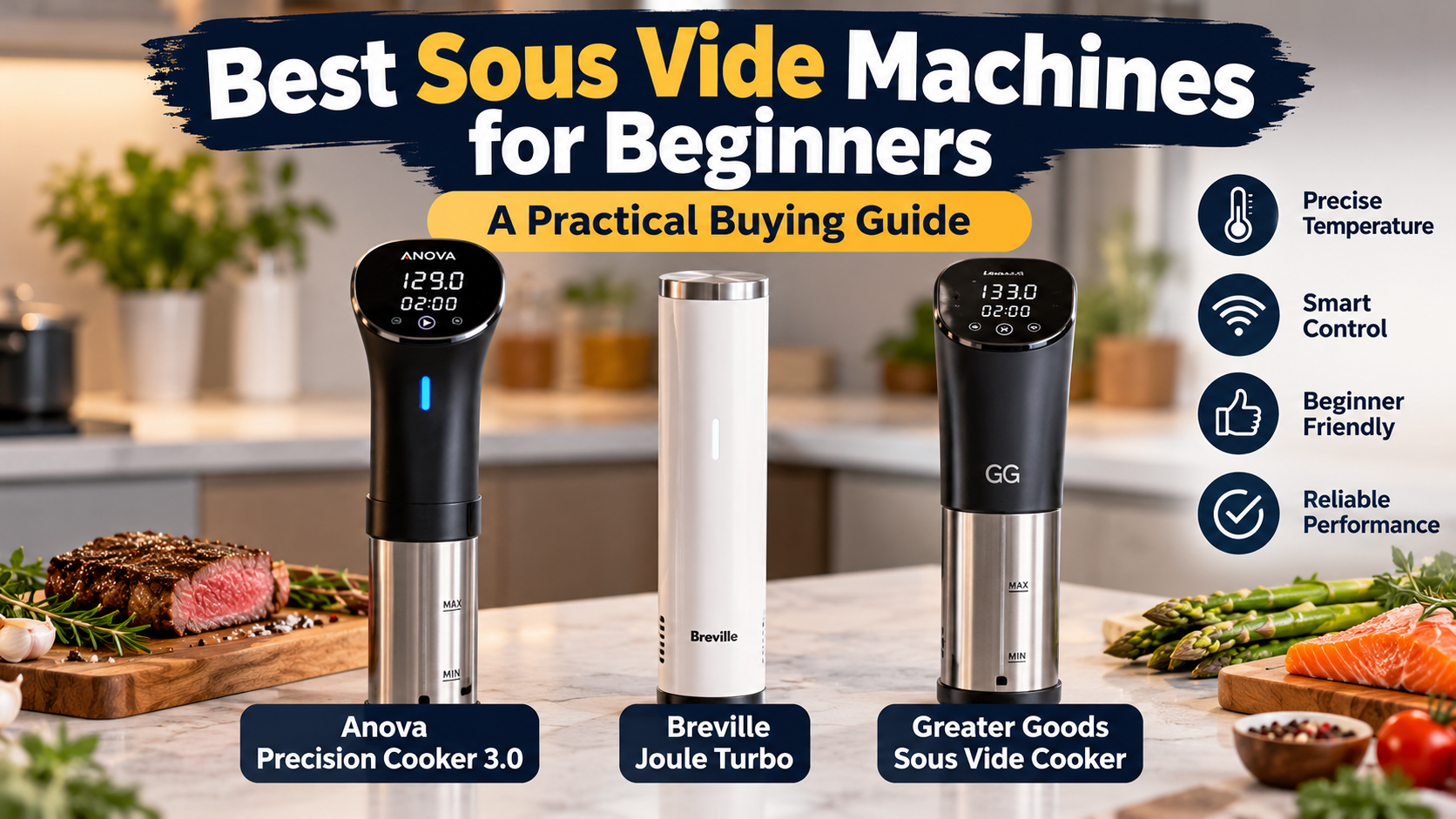
For most beginners, the Anova Precision Cooker 3.0 is a strong all-around choice thanks to its on-device controls and Wi-Fi connectivity. The Breville Joule Turbo is worth considering if you prefer an app-guided experience, while the Greater Goods Sous Vide Cooker is an appealing alternative if you want to cook without relying on a phone.
Below, we compare these three machines, explain their advantages and limitations, and help you decide which one best fits your kitchen.
Our Top Pick for Beginners: Anova Precision Cooker 3.0
Why we recommend it: Anova combines easy-to-use on-device controls with optional Wi-Fi features, making it a flexible first sous vide machine. Read the full comparison below to see whether it fits your needs.
Quick Comparison: Best Sous Vide Machines for Beginners
| Machine | Best For | Controls | Main Advantage |
|---|---|---|---|
| Anova Precision Cooker 3.0 | Best overall | On-device and Wi-Fi app | Flexible everyday operation |
| Breville Joule Turbo | App-guided cooking | Connected app | Guided cooking and Turbo features |
| Greater Goods Sous Vide Cooker | Simple manual operation | Built-in dial and display | No app or Wi-Fi required |
Product availability, prices, included accessories, and app features may change. Check the current Amazon listing and manufacturer information before purchasing.
1. Anova Precision Cooker 3.0 — Best Overall for Beginners
The Anova Culinary Precision Cooker 3.0 is a practical choice for someone who wants to learn sous vide cooking without committing to an app-only setup. Its combination of built-in controls and Wi-Fi connectivity offers flexibility as your cooking confidence grows.
Key Features
- 1100-watt heating element.
- Wi-Fi connectivity for compatible app-based features.
- On-device display and controls.
- Clamp-style attachment for a suitable cooking vessel.
- Designed to circulate water and maintain a selected cooking temperature.
What We Like
- Flexible controls: Set up a cook directly on the device or use connected features.
- Beginner-friendly format: The familiar immersion-circulator design works with many suitable pots.
- Room to grow: Useful for basic steak dinners as well as longer cooking projects.
Potential Drawbacks
- Costs more than some basic non-connected circulators.
- Some app content or features may require a subscription; check Anova’s current terms.
- Like other immersion circulators, it needs a suitable water container and properly packaged food.
Best for: Beginners who want a versatile sous vide machine with both physical controls and smart features.
Check Anova Precision Cooker 3.0 on Amazon
2. Breville Joule Turbo — Best for App-Guided Cooking
The Breville Joule Turbo Sous Vide is a compelling option for home cooks who enjoy using a smartphone for cooking guidance and control. Instead of emphasizing a traditional control panel, the Joule experience centers on its connected cooking app.
Key Features
- Connected, app-focused cooking experience.
- Guided cooking features for supported foods and recipes.
- Turbo cooking functionality for compatible cooking scenarios.
- Compact immersion-circulator format.
What We Like
- Helpful guidance: An app-led workflow can make unfamiliar cooking techniques easier to approach.
- Streamlined design: A compact device that fits into a modern kitchen setup.
- Turbo functionality: Offers an additional cooking option where supported by the recipe and app.
Potential Drawbacks
- The app-centered approach may not appeal to cooks who want physical temperature controls.
- Turbo functionality does not apply to every recipe or ingredient.
- App compatibility and supported features should be confirmed before purchase.
Best for: Beginners who prefer guided recipes, smartphone controls, and a connected cooking experience.
Check Breville Joule Turbo on Amazon
3. Greater Goods Sous Vide Cooker — Best for Simple Controls
Not everyone wants another kitchen appliance that depends on a smartphone. The Greater Goods Sous Vide Cooker focuses on straightforward operation with a built-in dial and display. This makes it especially interesting for beginners who value simplicity.
Key Features
- 1100-watt heating element.
- On-device dial and LED display.
- No Wi-Fi or smartphone app required.
- Brushless circulation motor.
- Adjustable temperature and timer settings.
- Temperature range of approximately 68°F to 203°F, according to the manufacturer.
What We Like
- Simple operation: Adjust settings directly on the machine.
- No connectivity setup: You can begin cooking without pairing a phone.
- Useful core features: A timer, temperature display, and circulation system cover the essentials.
Potential Drawbacks
- No remote monitoring or app-guided cooking.
- Fewer smart features than the Anova and Breville options.
- The design may feel less convenient if you prefer phone-based recipe guidance.
Best for: Beginners who want a straightforward immersion circulator with physical controls and no app dependency.
Check Greater Goods Sous Vide Cooker on Amazon
New to sous vide? Start with our step-by-step sous vide guide for beginners. If you are deciding between cooking methods, read our sous vide vs slow cooker comparison.
Which Sous Vide Machine Should You Buy?
The right choice depends less on the number of advertised features and more on how you prefer to cook.
- Choose Anova Precision Cooker 3.0 if you want a balanced combination of on-device controls and Wi-Fi features.
- Choose Breville Joule Turbo if you like app-guided cooking and want access to its compatible Turbo cooking features.
- Choose Greater Goods if you prefer physical controls and want to avoid phone or Wi-Fi setup.
For a first sous vide machine, reliable temperature control, a secure attachment, and an interface you understand are more important than having the longest feature list.
What to Look for When Buying a Sous Vide Machine
1. Easy Temperature and Timer Controls
A beginner-friendly machine should make it simple to select a temperature, set a timer, and confirm that the water is heating. Some models use built-in displays; others rely more heavily on a mobile app.
2. Heating Power
Heating power affects how quickly a machine can bring water toward its target temperature, although the container size, starting water temperature, lid, and room conditions also matter. The Anova Precision Cooker 3.0 and Greater Goods model reviewed here are both rated at 1100 watts.
3. Water Circulation
Circulation helps distribute heat throughout the water bath. Look for a machine designed for the amount of water you normally plan to use, and follow its minimum and maximum water-level markings.
4. App Controls Versus Physical Controls
App-based systems can offer guidance and convenience, but they introduce another setup step. Physical controls are often easier for cooks who want to set a temperature and get started immediately.
5. Container Compatibility
Many immersion circulators work with a suitable large pot or food-safe sous vide container. Before buying, check the clamp design, required water depth, and manufacturer’s recommended bath capacity.
6. Total Setup Cost
The cooker itself may not be your only purchase. You may also need a suitable container, food-safe bags, and possibly a rack or lid. A vacuum sealer can be convenient, but it is not mandatory for every beginner recipe.
What Equipment Do Beginners Need for Sous Vide Cooking?
You can begin with a relatively simple setup:
- A sous vide immersion circulator.
- A suitably sized pot or heat-safe container.
- Food-safe bags appropriate for the cooking temperature and duration.
- A way to keep the bag submerged.
- A skillet or other suitable cooking surface if you want to sear meat after cooking.
For some recipes, the water-displacement method can remove air from an appropriate resealable bag without a vacuum sealer. Always use bags suitable for the intended cooking conditions.
If you want to prepare food in advance or package ingredients more efficiently, see our guide to the best vacuum sealers for beginners. You can also read how to use a vacuum sealer and our comparison of vacuum sealers vs. freezer bags.
How to Use a Sous Vide Machine: Beginner Overview
- Prepare the container: Fill a suitable pot or sous vide container with water within the machine’s indicated limits.
- Attach the circulator: Secure it according to the manufacturer’s instructions.
- Set the cooking temperature: Use a trusted recipe with appropriate food-safety guidance for the specific ingredient and thickness.
- Package the food: Place it in a suitable food-safe bag and remove excess air using an appropriate method.
- Cook for the required time: Follow a validated time-and-temperature guide, accounting for the food’s thickness and whether it starts fresh or frozen.
- Finish if needed: For steak or similar foods, carefully dry the surface and sear briefly in a hot pan.
- Serve or chill safely: If not eating immediately, follow proper rapid-chilling and refrigerated-storage guidance.
Food-safety note: Sous vide cooking requires appropriate combinations of temperature and time. Do not assume that a particular water temperature makes every food safe immediately. For meat, poultry, fish, and long cooking sessions, follow authoritative food-safety guidance and validated recipes.
Common Sous Vide Mistakes Beginners Should Avoid
- Using the wrong temperature: Different foods and desired textures require different settings.
- Ignoring cooking time: The center of thick food takes time to heat, and safe cooking may require additional holding time.
- Letting bags float: Floating bags can cause uneven cooking if food is not properly submerged.
- Overfilling or underfilling the bath: Stay within the circulator’s marked water limits.
- Skipping the finishing step: Sous vide produces controlled internal cooking, but browning usually requires a separate sear.
- Using unsuitable packaging: Choose food-safe bags rated for the intended temperature and cooking duration.
Frequently Asked Questions
Is a sous vide machine worth it for beginners?
It can be, especially if you frequently cook foods where precise temperature control matters. A sous vide machine makes it easier to manage the water temperature, although you still need to choose appropriate cooking times and follow food-safety guidance.
Do I need an expensive sous vide machine?
No. Beginners should prioritize dependable controls, suitable container compatibility, and the features they will actually use. A simpler non-connected model may be sufficient if you do not need an app.
Do I need a vacuum sealer for sous vide?
Not necessarily. Some beginner recipes can be prepared using the water-displacement method with an appropriate food-safe resealable bag. A vacuum sealer becomes more useful for frequent cooking, meal preparation, and certain longer cooks.
Can I use a regular pot for sous vide?
Often, yes. The pot must be suitable for the temperature and water volume, and the circulator must attach securely. Check the manufacturer’s minimum water depth and other setup requirements.
Is Wi-Fi necessary for sous vide cooking?
No. Wi-Fi can add convenience and app-based features, but it is not required for precise water-bath cooking. The Greater Goods model in this guide operates with built-in controls.
What is the difference between Anova and Breville Joule Turbo?
The Anova Precision Cooker 3.0 offers on-device controls alongside Wi-Fi features. The Breville Joule Turbo places greater emphasis on an app-guided cooking experience and its compatible Turbo cooking functionality. Your preferred control style is an important factor in choosing between them.
Final Verdict
For most beginners, the Anova Precision Cooker 3.0 is our preferred all-around option because it combines direct controls with connected features. The Breville Joule Turbo is particularly attractive for cooks who want smartphone-guided recipes, while the Greater Goods Sous Vide Cooker is a sensible choice for anyone who wants a simpler, app-free experience.
Whichever machine you choose, start with a reliable beginner recipe, use suitable packaging, and pay close attention to cooking time and food safety. Good technique matters just as much as the appliance.
Ready to compare the options?
3 thoughts on “Best Sous Vide Machines for Beginners: A Practical Buying Guide”